Being that I’m an
electrical engineer, I tend to view most things in a straight manner. For the
last three years of my attendance at RPI, I interpreted almost everything my
professors had taught me as strictly black or white (either useful to my future
or not). My entire perspective of the news changed, and I actually began to
lost interest in the world around me. Taking this class, I expected to gain
some respect for the media, and perhaps some new analytical skills. In the end,
I never expected for the class to completely overhaul my perspective of the
media.
Upon
entering this class, I expected an explanatory lecture with occasional analysis
of the NY Times. Essentially, I thought that the professor was going to just
show us a procedure involving reading the Times, and then test our knowledge of
the procedure. Unexpectedly, the class took a unique turn: we reviewed current
events and aspects of the media in great depth. The topics were incredibly diversified,
ranging from reviewing the legitimacy of politicians/electoral campaigns, to
the motives behind war and conflict worldwide. The class even reviewed
less-specific events, such as evolution of gender-biasing.
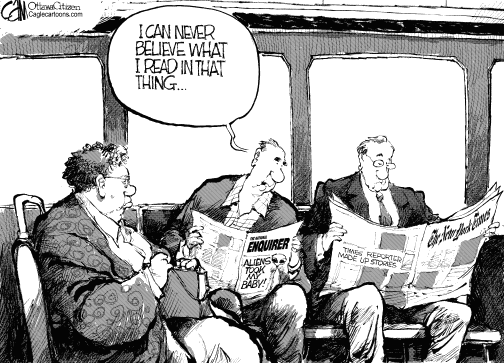
 I've always been somewhat gullible when it comes to information that I've been told. I've relied almost entirely on a small quantity of media networks (Yahoo.com
and Fox News, primarily) for weekly information, and never really thought much
about the news. Only now do I realize how blind I truly was. This class helped
me to realize that most of my opinions were entirely lined up with the bias of
the media which I watched. While that sounds obvious in retrospect, at the time
I was almost completely ignorant of that fact, and just tended to take a stance
that parallels the media bias. I've learned much: now, I don’t accept things as
I first hear them. I find myself looking at every side of an argument, not just
what I see in the media. The best way to elaborate on this would be with an
example: consider the “Dark Knight” massacre in recent news. The media has not said
much about the patient’s sanity, but I considered the possibility that he was
insane immediately upon hearing the case. I knew for a fact that he was going
to claim insanity as a defense, and my estimate was confirmed in headlines from
a few days ago, stating just that.
I've always been somewhat gullible when it comes to information that I've been told. I've relied almost entirely on a small quantity of media networks (Yahoo.com
and Fox News, primarily) for weekly information, and never really thought much
about the news. Only now do I realize how blind I truly was. This class helped
me to realize that most of my opinions were entirely lined up with the bias of
the media which I watched. While that sounds obvious in retrospect, at the time
I was almost completely ignorant of that fact, and just tended to take a stance
that parallels the media bias. I've learned much: now, I don’t accept things as
I first hear them. I find myself looking at every side of an argument, not just
what I see in the media. The best way to elaborate on this would be with an
example: consider the “Dark Knight” massacre in recent news. The media has not said
much about the patient’s sanity, but I considered the possibility that he was
insane immediately upon hearing the case. I knew for a fact that he was going
to claim insanity as a defense, and my estimate was confirmed in headlines from
a few days ago, stating just that.
“How to Read the
NY Times” was a refreshingly intriguing experience. I enjoyed how in-depth my
professor would go into the discussions, as well as how he constantly tried to
communicate on a level which we all could relate. His discussions on
controversial topics (inappropriate video games, marijuana legalization, etc.)
had always managed to catch my eye. The professor constantly attempted to get
the class involved, typically by gauging our reaction to a topic or by asking
about our thoughts on it. There was almost never a dull moment in the
classroom. I had very few dislikes about the class. I suppose one would be,
without attempting to sound too much like a “suck-up”, that it was too short.
There were definitely more than enough days to discuss much more material than
we covered, but due to the common occurrence of the class/professor being
caught up in a discussion, the class tended to not cover as many headlines as I
would have preferred. Additionally, it seemed like some of the sections which I
would have personally preferred to hear about weren’t always covered. Though
not always significant, the tech/science sections of the news were rarely
discussed in class. I find that somewhat disappointing, however, the lack of
discussion encouraged me to read more from those sections on my own time. That,
in turn, lead to a large portion of my entries revolving around breaking news
in the tech/science community.
This class was a
surprisingly pleasant change from typical humanities courses at this college. I’ve
gained countless new perspectives on topics and ideas about situations. I find
myself with the ability to clearly distinguish and analyze commercial media
from non-profit media. I constantly critic and analyze advertisements now, as
opposed to before when I was prone to developing a strong stance on something
based on heavy media influence. I even find myself looking into the economic
impact on the media, something which I’ve never even bothered to consider. Overall,
this was quite an enjoyable class that has opened my mind to a world of
possibilities.

No comments:
Post a Comment