Sunday, August 12, 2012

My Night with Race-Music


Being a child of the late 20th century, I’ve never personally seen any strong cases of racial bias or racism. The topic is commonly seen in the media and despite equality for all races in the modern world, is a thought on everyone’s mind at one time or another. For the most part, it seems like the media uses it as a “hook” in stories; they just attempt to use racism as a means of grabbing attention. However, there are people out there who actually still support racist beliefs. As my professor had pointed out, there are individuals who express their racist opinions by means of song. After hearing this, I couldn’t help but check out this “race-music”.
                 The very thought that one is superior to another because of their race or color is a preposterous claim based on no evidence whatsoever. It originated back when Europeans came to this country and found less advanced natives (lacking the technology that Europe had). I had always believed that the primary racist groups (the KKK, for example) essentially died out when this country made racism illegal. Apparently, this isn't the case, as the KKK’s website still exists. The main reason that they are able to do so legally is that they switched their message from one of hate towards other races to one of pride for their own. Upon doing more research, I discovered that the main way that they gain support isn't through direct recruitment, but rather through music.
The Deceptively Comforting cover
of a "Prussian Blue" Album
                Music is a powerful tool, proven time and time again to influence one’s opinions in amazing ways. I personally have developed many new ideas and shifted my opinions based on music that I’ve listened to. As my professor stated, race-music can take almost any form, but would be expected to take the form of some punk/rock genre. This would appeal to a younger generation of individuals who haven’t been entirely influenced by the media. As somewhat of an experiment, I made an attempt to listen to this music. Originally, I assumed it was going to be a horrible experience, but found myself surprised in a horrifyingly different manner.
                I’m a fan of music in general, with no opposition to any genre. Usually, I listen to punk/rock genres more than others, and as such, decided to dabble into the punk/rock based race-music available on the internet. I immediately stumbled into the heart of this music, searching on the KKK’s website for “white pride” music. The music, despite being claimed as pride music, was almost entirely dedicated to insulting other races. The themes included forcing other individuals out of America due to their skin color, and taking back the nation for “the white man”. Immediately, I wanted to stop the music. Through sheer willpower though, I managed to continue listening, and found myself actually enjoying the music for its rhythm and tone. After listening to a few of these songs, I was surprised at the fact that I was actually enjoying this music. It started to make sense that unaware teenagers and younger generations (assumedly who this music targets) would listen to this with little regret. It quickly became obvious that prolonged exposure to this music could allow hateful opinions to blossom in young minds.
The media’s portrayal of these groups is almost purely negative all the time. The first thing that stands out about these groups is their hate for other races; this is a direct result of media influence. In an article awhile back, I’ve read that there was a duo, known as "Prussian Blue" who sang songs promoting Nazism. The two members of the group were blond hair, blue eyed teenage girls who sang country hate music. They praised Hitler, and after listening to their oddly “comforting” soft music, I found myself more at-ease and analyzing almost everything to prevent falling under its spell. The media is correct for the most part when it comes to this dangerously intense genre of music. Using a comforting tone as opposed to a harsher one has the scary end result of luring listeners into a false sense of security.
Although the media’s interpretation of these forms of spreading ideas is constantly negative, there are bands in existence that simply spread pride messages. I agree that some of the music may come off as strong, and the majority of it actually is racist, but there are some groups whose goals are to express racial pride, not direct hate. Common examples of these are the black pride musicians of history, who sing of the hardships that they've overcome. I’ve listened to several of these songs, mainly falling under the genre of jazz/R&B. The tunes soothe the mind, while reminding the US that African Americans are equal individuals in every respect. Regardless of their message of peaceful pride, they are categorized under the genre of “race music” by the media. It seems somewhat wrong that a few these groups are attacked for spreading pride for their races and expressing their beliefs.
While the media accurately portrays the majority of “pride” groups, I truly don’t believe that all of these groups should be classified by their music. True, the KKK has expressed a message of pure hatred for other races through their songs, but other groups (such as “black pride” groups) have expressed pride instead. In all honestly, I see nothing truly wrong with singing of how proud your race or how great your own beliefs are. The only problem arises from the messages of hate which all-too-commonly accompany these pride messages. In the end, white or black, Christian or Atheist, we’re all American.


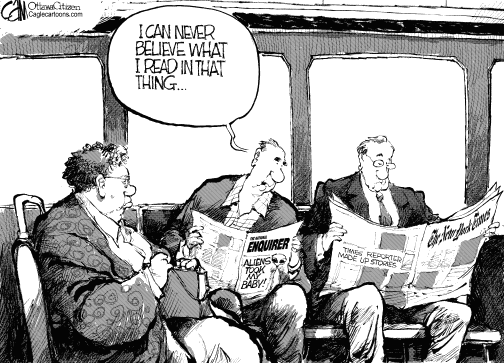
How to REALLY Read the NY Times


Being that I’m an electrical engineer, I tend to view most things in a straight manner. For the last three years of my attendance at RPI, I interpreted almost everything my professors had taught me as strictly black or white (either useful to my future or not). My entire perspective of the news changed, and I actually began to lost interest in the world around me. Taking this class, I expected to gain some respect for the media, and perhaps some new analytical skills. In the end, I never expected for the class to completely overhaul my perspective of the media.
                Upon entering this class, I expected an explanatory lecture with occasional analysis of the NY Times. Essentially, I thought that the professor was going to just show us a procedure involving reading the Times, and then test our knowledge of the procedure. Unexpectedly, the class took a unique turn: we reviewed current events and aspects of the media in great depth. The topics were incredibly diversified, ranging from reviewing the legitimacy of politicians/electoral campaigns, to the motives behind war and conflict worldwide. The class even reviewed less-specific events, such as evolution of gender-biasing.  
                I've always been somewhat gullible when it comes to information that I've been told. I've relied almost entirely on a small quantity of media networks (Yahoo.com and Fox News, primarily) for weekly information, and never really thought much about the news. Only now do I realize how blind I truly was. This class helped me to realize that most of my opinions were entirely lined up with the bias of the media which I watched. While that sounds obvious in retrospect, at the time I was almost completely ignorant of that fact, and just tended to take a stance that parallels the media bias. I've learned much: now, I don’t accept things as I first hear them. I find myself looking at every side of an argument, not just what I see in the media. The best way to elaborate on this would be with an example: consider the “Dark Knight” massacre in recent news. The media has not said much about the patient’s sanity, but I considered the possibility that he was insane immediately upon hearing the case. I knew for a fact that he was going to claim insanity as a defense, and my estimate was confirmed in headlines from a few days ago, stating just that.

“How to Read the NY Times” was a refreshingly intriguing experience. I enjoyed how in-depth my professor would go into the discussions, as well as how he constantly tried to communicate on a level which we all could relate. His discussions on controversial topics (inappropriate video games, marijuana legalization, etc.) had always managed to catch my eye. The professor constantly attempted to get the class involved, typically by gauging our reaction to a topic or by asking about our thoughts on it. There was almost never a dull moment in the classroom. I had very few dislikes about the class. I suppose one would be, without attempting to sound too much like a “suck-up”, that it was too short. There were definitely more than enough days to discuss much more material than we covered, but due to the common occurrence of the class/professor being caught up in a discussion, the class tended to not cover as many headlines as I would have preferred. Additionally, it seemed like some of the sections which I would have personally preferred to hear about weren’t always covered. Though not always significant, the tech/science sections of the news were rarely discussed in class. I find that somewhat disappointing, however, the lack of discussion encouraged me to read more from those sections on my own time. That, in turn, lead to a large portion of my entries revolving around breaking news in the tech/science community.
This class was a surprisingly pleasant change from typical humanities courses at this college. I’ve gained countless new perspectives on topics and ideas about situations. I find myself with the ability to clearly distinguish and analyze commercial media from non-profit media. I constantly critic and analyze advertisements now, as opposed to before when I was prone to developing a strong stance on something based on heavy media influence. I even find myself looking into the economic impact on the media, something which I’ve never even bothered to consider. Overall, this was quite an enjoyable class that has opened my mind to a world of possibilities.

Thursday, August 9, 2012

Females in Video Games: Misrepresented or Misinterpreted?


The entertainment industry of today’s world is moving more and more towards a digital platform. Children of all ages, as well as some adults, are taking part in the digital entertainment revolution, where video games and fictional worlds reign supreme. A couple of weeks ago, I wrote an article about violence in video games. In it, the violence in games is described, as well as the possible outcomes of the violence (i.e. corruption of younger minds that play them). Sometime later, I wrote another article about gender bias and how the media generally classifies women as inferior to men. It was not until now that I realize that the two articles could overlap to bring one major problem to light: gender bias in video games.
                As my professor stated in lecture, the classification of females is prominent in many aspects of video games. For example, in the “Grand Theft Auto (GTA)” franchise, women are portrayed as objects. They exist only to attract the gamer’s attention, and provide no actual sustenance to the game. The gamer is, thus, inclined to perform deplorable acts, such as murdering them or soliciting sex from them, simply because they can. I've thought in a similar manner when playing video games. I would never be able to do the majority of the things possible in that game in real life. Hence, when given the option to try it without hurting anyone or any consequence, I don’t really hesitate. It’s fun and entertaining to watch a “what if” scenario that would be otherwise impossible to witness. However, those too young to view these scenes (anyone under the age of 16 in my opinion) may not realize the distinction between reality and fiction.
In my video game article, I described a similar concept, where young minds don’t realize the difference between the real and the fictional. One must consider, though, what happens when something less obvious occurs. When children play games that portray women in a stereotypically degrading fashion, they are more likely to view them in that light. Similar to how one may not distinguish reality from fiction in violent games, younger individuals may not notice the difference between women in games and women in the world today. Obviously, women have equivalent rights in the world today. Portraying women as they once were seen (as objects) to younger minds will inevitably lead to biased views of women as inferiors.
In the textbook “Media and Culture”, a specific example of bias is used: a game known as “Red Dead Redemption”. The game follows a cowboy during the old western era in the US, taking place on the Mexican border. The article tends to describe the game as having no redeeming social value, and being on-par with GTA in its treatment/perspective on women. The game, though it does indeed tend to portray them in a negative manner, does so in an acceptable fashion. To elaborate, the game is highly consistent with the views and opinions of the world at that time. Women are seen as objects, but as most historians know, women were viewed as inferiors to men at that time. The game does not directly force you to kill a woman for fun. The book is incorrect in its description of forcing the player to “tie a woman to train tracks and wait for an oncoming train to kill her”. That instance is optional: something that the player can do of their own accord. They can still progress to the end of the story without doing it. The only motivation for completing this action is an achievement (something that Xbox players are familiar with), ironically titled “Dastardly”. As a side note, the achievement is reminiscent of the “dastardly” fiends in older western cartoons who do the same, and aren’t nearly as highly criticized.
If History had Achievements...
As stated above, the game takes place in an accurate western setting. The game itself has many redeeming social values. For example, the player is able to assist the sheriff of a town in capturing criminals, some of whom are based off of actual criminals known in that time. There are no Native Americans present in the game, but the main reason for this is that the game primarily takes place in Mexico, not America. Perhaps one of the most unique concepts is its take on the buffalo extinction in the area. The game actually has an achievement for killing every Buffalo in the “Great Plain” region, titled “Manifest Destiny”.
From the rating system, to other games, to countless cases of sexual harassment, the list of topics which can be reviewed to fuel the discussion on “underage gaming” is ever-expanding. The argument here is simple enough. Although the concept of women portrayed as objects in video games is obviously negative, historical games which do so cannot possibly be considered inappropriate. The only reason a game such as Red Dead would be inappropriate would be if it were sold to minors: an audience that the game wasn’t even designed for. When minors obtain games like these, they end up developing biased opinions. This is clearly seen in the recent NY Times article, where a gamer girl was harassed by her peers. While inappropriate games exist, the media should switch their focus from bashing the games themselves to bashing the stores that sell those games to minors. Simply regulating the flow of information, something which our government has been actively doing in other areas, would solve this issue in its entirety.

Move Over Flying Cars: Here Comes Hydroelectric Engines


For years, man has dreamed of cleaner, more efficient means of transportation. The dream, first, led to the idea of a flying car, similar to one seen in the cartoon “The Jetsons”. The flying car sparked worldwide interest, and inspired various individuals to construct a similar device. To this day, the search for a similar flying car continues, but to little avail. The search for this car, though not entirely successful, has sparked interest in others methods of clean transportation vehicles. One such vehicle is a water-powered car, an idea which a Pakistani scientist claims to have successfully developed.
                 The water-powered car is, as the name suggests, a car that has an engine which runs entirely off of water. The separation process of molecules of bound water produces energy, but until now, nobody has been able to successfully utilize the energy released. As with any ground breaking discovery, the claim is under speculation. If one recalls the Higgs-Boson Particle (God Particle) incident back about a month or so ago, they will understand what I mean. As soon as it was claimed that particles which were in existence during the Big Bang were discovered, people everywhere experienced mixed feelings of uncertainty and hope. This seems to be the case in any situation with a major discovery.
                In the article in the NY Times, the car is criticized highly. The author of this article, titled “Boast of Water-Run Car Thrills Pakistan”, claims that more evidence is required before anyone is to get excited about the car. The author describes the claims as “spectacular” and “violating ironclad laws of physics”. Despite this, the article seems to have taken the tech section by storm in the last few days. The very idea that a water-powered car has been created fills my mind with wonder and pure hope. I’ve always believed that anything can be accomplished if one sets their mind to it. This case is no different. The fact that this author agrees that the laws of physics are definitive and unchanging is frustrating. It has been proven time and time again that there are ways to defy physics. The boundaries set by physics exist only because mankind allows them to exist. As was said in my other article, “Touchdown Confirmed”, mankind’s greatest characteristic is its ability to question the known and the accepted. It is through this questioning that new ideas form, and hundreds of possibilities are revealed.
http://media.treehugger.com/assets/images/2011/10/genepax-water-powered-car-001.jpg
A model for a water-powered car
It seems clear that either this man is either going through an immense amount of effort to gain an excess of attention, or that his claims are accurate. The man went through the trouble of displaying his invention on live television, and allowed some unaffiliated individual to test it. He must be undergoing extreme stress, attempting to prove he has made a groundbreaking discovery to no avail. I, for one, believe in the man’s claim. In the past, despite the existence of numerous claims of a water-powered vehicle, not a single one was proven successful. This claim, however, was not only proven, but has been consistently made by the same man for over a month now. I suppose that until the invention is investigated, presumably within the next few weeks, we truly cannot know for certain.
The media continually bashes ideas which contradict the norm. When an idea or experiment that defies what we know arises, the media doesn’t typically stop to question the legitimacy of the claim. They automatically assume that it will fail, but imply that they will keep a somewhat open mind to the possibility. This case is no different: the media essentially believed that this was a falsified claim. The man in this story has been working for well over a month to show the world that his invention is a scientific feat. It was not until his experiment was shown in action publicly (multiple times) that the media even decided to glance in this man’s direction. This boundless skepticism of the media shows just how biased and stubborn it can actually be.
One must ask themselves why a man from a poor country would make a false claim about this. It doesn’t seem like the man is down on his luck: he’s maintained a job with local police forces, and has obtained a degree in mechanical engineering. True, the man is an unlikely source for such a substantial discovery to be made. In reality though, the majority of large discoveries have originated in the most unlikely of places. Back in the day, it was an accepted fact that the world was flat. About 50 years ago, it was an accepted fact that mankind would never make it to mars, let alone the moon. It’s obvious that accepted facts are only accepted because we accept them as they are. By refusing to question an idea, it becomes accepted. By questioning the accepted, not even the sky can limit us as a race. Always remember: the only impossible ideas are the ones which are abandoned.
The general accepted schematic for a Hydro-Electric Car's Engine

A Curious New Search for Life


In the last year, NASA has been planning future space exploration. With the cancellation of the shuttle program in the US, theories have risen, revolving primarily around the concept of NASA’s development of pod-like capsules which launch single passengers into space. Plans for a space elevator, capable of transporting large quantities of supplies into our atmosphere, have been released to the public. Additionally, perhaps their boldest move yet, they have announced the plans for man to land and settle on the moon in approximately 10 years. These groundbreaking announcements have only served to hype up the most recent in NASA breakthroughs: a rover on Mars.
The complex maneuvers required to land the rover
                NASA has been preparing their rover, nicknamed “Curiosity”, for its descent to the surface of the red planet. As an article in the New York Times states, this is the first time that Earth has successfully placed a mobile laboratory on the planet. The rover is tasked with the mission to search for carbon-based particles. Should carbon be found, it would serve to support the fact that life once existed on the planet. The mission is one of the most controversial ones, as there are a good number of individuals who claim that, at this time, it is a waste of money. This is simply preposterous.
                The search for extraterrestrial life and expansion of humanity to other worlds should a priority in these times. It has become evident that our population will continue to increase, exponentially, until natural selection eventually allows the rate of expansion to taper off. Regardless whether or not it tapers off, conditions on this planet will only get worse. Overcrowding, global warming, famine, water shortages, and mass deaths seem like the most probable outcomes in such a scenario. If humanity makes the effort to push civilization’s boundaries beyond that stars, we can lessen our harmful impact on the Earth.

                Stating the obvious evolutionary benefits of expansion of humankind into space may not, by itself, serve to convince some of the necessity of space exploration. There are those who, despite piles of evidence, do not believe in things such as global warming or evident overpopulation. Those individuals must realize that this is an achievement, beneficial to our country. Though this is an achievement for all of mankind, NASA’s involvement with the government in accomplishing this feat is a way of displaying leadership and dominance. The Cold War may have ended years ago, but the Space Race has not stopped; it has only slowed down substantially. Any country that can successfully conquer the final frontier will only expand its influence over the world. By successfully landing the rover, the US has proven its dominance, and shown (at least to some extent) that it can accomplish nearly anything this nation sets its mind to.
                The media’s coverage of this event has greatly exceeded my expectations. Being that this is a science/tech article topic, I expected, at most, an honorable mention in the New York Times. I expected the Times to view this as just another rover landing on the planet, as this is now the third rover to touch down on Martian soil. To my disbelief, the Times covered this story to the fullest extent, interviewing technicians and engineers at NASA, as well as describing in full the technique the rover used to land on the surface successfully. I’m pleased to see this, as the rover (powered by plutonium) will be running for years, possibly decades, to come. They even went as far as to describe the planned first mission for the rover, rightfully so. Thanks to the Times, and other well-accredited news sources, this great moment in world history will not be overlooked by the masses.
I’m well aware of the enormous amount of time, effort, and money that it takes to launch and land a rover on a foreign planet. It’s a ton of work, and in the end, if one wrong move is made, the rover could be destroyed. However, if mankind never dared to venture where no other creature has gone, the world as we know it would not have been documented. Had Columbus never attempted to venture beyond the horizon, the world would have remained flat in our eyes. The most distinguishing ability of humans is not their ability to use tools, or their advanced knowledge over others, but their ability to question the unknown. Indeed, it has been shown time and time again: one small step onto a new frontier can be a giant leap for mankind.

The Digital Age: A Flawed Disaster in the Making


The Digital Age has been reinventing the way that people in this world interact. In just 10 short years, people have moved on from using hulking machines that struggle to perform basic tasks. Research shows that the average American uses more than 30 different machines in a day. That number is projected to increase exponentially over the next 5 years. Eventually, the majority of tasks in the workplace will be given to machines. Knowing this, I can’t help but wonder how long until our current technology is so inefficient that we are forced to upgrade.
                In history, mankind made strides towards a much more automated future. In recent years, mankind has made leaps and bounds. As my professor stated early on this semester, there are plans to eliminate the use of paper for newspapers altogether. In a matter of years, the times will be distributed via data chip or direct download to tablets which subscribers can purchase. The paper is already available online, as well as on certain tablet/smart phone devices via apps. I understand that increasing accessibility is beneficial, but producing a tablet that will potentially end the paper as we know it may not be the best thing.
                I must revisit one of my previous articles: my review of the dark knight. The movie did a great job of reinventing the comic franchise, but the problem lies within the reinventing phase. The movie, as good as it was, had significant differences from the comics. Not only did it confuse some comic book fans by withholding some key ideas, but it also happened to alter how these characters are portrayed to the public. The original is always better, since any deviations from an original storyline are prone to error/plot-holes. In the case of evolution in media, the same can be said. As we move towards new innovative methods of communication, there will be flaws and issues. In order to overcome those flaws, more advanced forms of technology will be released. Those new forms of tech are almost guaranteed to have, if not eventually develop, flaws, and require replacement. This never-ending loop will prove to be a money sink in time.
                The technological advances in the world open new windows to much greater problems than flaws. Let’s consider the idea of a New York Times tablet which is commercially distributed to subscribers. The information is downloaded onto their tablets, where viewers can assumedly safely view it. However, in order for the Times to check if you are subscribed, there must be some identification on your tablet. There is virtually nothing but time separating your personal identification, as well as vital information, from hackers. As tech advances, so will man’s ability to manipulate it to their will, legally and illegally. It’s been done before, from using a simple virus on a single computer to bringing down a gaming industry’s servers (referring to Sony’s PS3 hacking incident). Regardless, it remains evident that it is much less plausible to hack into a physical paper then to hack into an electronic tablet.
With a book like this, hacking the media seems 
more like an inevitability than a possibility 
Computers aren’t as perfect as they may appear. This leads us to ask questions: what happens if the computer messes up one day, and doesn’t update? What if conflicting information is printed in the times unintentionally? If “spellcheck” accidentally changes one word in every instance to its opposite (“can” to “can’t” for example), the story could cause confusion. Chances are, in a more “advanced” world that relies on machines more, there would be a greater chance of mistakes occurring. Machines aren’t perfect; they can make mistakes just like us. If a mistake arose, it could potentially be more harmful than a human error though, as machines lack one thing that humans still have: judgment. Normally, a human would carefully examine the words and grammar after a computer had. If technology were to take over the business, we would be essentially leaving the task of media distribution entirely in the hands of our creations.
                If there is a problem in the world, scientists will work to solve that problem. Any technology that scientists and engineers create with the intention of solving a problem will actually serve to better mankind. If the problem at hand is faulty technology, the tech should be fixed; a newer model shouldn’t be released to solve the problem. Being an engineer, I’m not against the advancement of technology. However, I believe that the “revolutionizing” of the paper is something unnecessary and risky. Reading paper-based products has been a tradition for thousands of years now. The process of producing paper-based products has been brought to a near-perfect state. Revolutionizing the paper at this point would prove, inevitably, to be more trouble than it’s worth.

Monday, August 6, 2012

Marijuana: A Double Toke


As the 2012 decision date draws nearer, the presidential candidates have been arguing over controversial issues. Both candidates are doing whatever they can to gain support from the American people. Now more than ever though, the most controversial topic on the board for discussion is the legalization of marijuana. After seeing this topic appear in the news multiple times, as well as hearing my professor discuss it during lecture, I couldn’t help but revisit the topic.
                In my previous entry, I took an informative approach discussing the history of marijuana and it’s crippling by the media. I would like to elaborate on that this time around, as well as contribute something extra. In the recent election, marijuana legalization has been a primary issue, as was stated previously. The primary reasons for this can be contributed to multiple sources. The medicinal marijuana business would help our economy, contributing massive pools of income. The herb, though it would be hard to regulate and detect in one’s body instantaneously, has been proven to be the cause of a near-zero quantity of deaths. Just knowing these facts, one can only assume that the executive decision has not been made at the current time. In reality, however, the media has been completely diluting the idea of legalization with corrupt undertones.
President Barack "Choom" Obama
                The idea that the media is corrupt is a comment one may humorously assume came from a “hippie”. People want to have faith in their government, and want to believe that the media is telling the entirety of the truth. However, the media’s corruption is all too real. A few weeks back, a story arose describing how President Barack Obama had been an avid marijuana smoker for years when he was a child. He would actually go around his hometown calling his small group of friends “The Choom Gang”, choom being a term used to describe pot smoking. The article was the center of attention for almost a full week, and then almost seemed to fade away into non-existence. Can one really assume that people lost interest in the fact that our president used to smoke, and continues to support pot legalization? Of course not; look at all of the forums on the internet concerning marijuana. There are thousands of references on these sites to the now-public story of the Choom Gang, describing how marijuana supporters should rise up and seek legalization. As the election draws closer, the legalization may become a reality.
                “The opinions of the masses aren’t properly expressed in the few leaders of our nation in this case.” If that statement was false, there would not be such an active push for the legalization at this time. To me, it seems like a revolution is happening, which will improve the state of this nation. So much of the government’s money is pooled into the “necessary” war on drugs. Drugs, in general, are not good. However, when something less addictive and harmful than caffeine is illegalized, something is not right. The only public instances describing the “dangers” of marijuana occurred within the last few months. The recent mass-murder of 12 individuals in a movie theater by James Holmes is looked upon as one of the most tragic events in US history. The media, though it had plenty to report on, decided that it would be better to express the fact that Holmes was an avid pot smoker, only briefly stating that he was also taking a cocktail of other drugs in addition to that. This information was drawn directly from articles in both the NY times and yahoo.com. Simply knowing that the media has that much pull over the uneducated masses strikes me as terrifying.
                In reality, I’ve found that the media tends to cover the entire story for any article which will support long-accepted ideas. The idea that pot is evil has long been the norm, while actually multiple celebrities and successful individuals support it. For example, Michael Phelps, a long-time supporter of marijuana, has just won his 19th gold medal in this year’s Olympics. It didn’t cause his hair to fall out, or his body to shrivel to nothingness. In a recent interview with Jimmy Chong, another supporter of medicinal marijuana, Chong claims that he was able to fight back his cancer by controlled use of the herb. He stated, additionally, that in order for President Obama to secure the youth vote in this country, he (the president) would have to legalize pot. Looking at the legalized scenario, the benefits far outweigh the detriments.

Politics Then and Now


The recent electoral race between the two current candidates, Barack Obama and Mitt Romney, had started on the claim that neither side would resort to mudslinging. As my professor has pointed out, this claim has obviously not held up for long. Both Obama and Romney have been spewing forth ads which insult the other candidate, point out their faults, or tell (bluntly) of how they’re better than their opposing candidate. It truly makes me laugh at how often this happens.
            I’ve seen countless ads as a kid which target candidates in a negative manner. The ads usually tend to fire at someone for not supporting gay marriage, or being against/for abortion (either of which can be made to look negative). However, I’ve not seen many ads similar to the current ones being circulated, claiming that Mitt Romney wouldn’t be a good fit for president due to the fact that he is a Mormon. I've never once judged a person by the color of their skin, belief in a god, or opinions on a matter. The way I judge people are their openness to ideas, and their attitude towards such ideas. It just doesn't seem right for someone to judge someone else based on their beliefs. At the same time, Romney does not deserve the benefit of the doubt.
            Ever since he was elected, President Barack Obama was accused of not having an American citizenship. Romney has continued to fuel this argument throughout his campaign. He claims that Barack Hussein Obama was not born in America, and thus cannot be rightfully chosen as the president. The claim continues to spontaneously rise up in the news, but fades almost as quickly as it came. The last time Romney claimed that he had “surefire proof” that Obama wasn’t a US citizen was about a month ago. One week after the claim, everyone seemed to forget about it. Regardless, the mudslinging aspect of politics has always remained strong throughout history. A quick glance back in time shows that mudslinging has taken a different turn though.
            One of the very first ads which I remember seeing as a kid was entitled “Daisy”. The ad involves a young girl counting the number of pedals she pulls off of a daisy. When she hits a certain number, her voice fades away slowly, and is replaced by a serious sounding announcer-type voice counting down. When the voice counts to zero, an image of a missile being launched is shown, followed by a close-up on the girl’s eye. In her eye, you can see the image of a mushroom cloud explosion, followed by the screen flashing white. The message was played in the election of Lynden B Johnson. Many interpreted it as a means of instilling fear into the nation, attempting to persuade citizens to vote for JFK. However, the true message is clear: the ad is persuading individuals to vote against Barry Goldwater. The film almost directly displays that if Goldwater is elected to office, the country will be in a nuclear crisis. The ad aired during the crucial time of the Cold War, making matters worse. This “fear as a weapon” campaign advertisement is much different in comparison to the Romney/Obama election, but the message remains: “My opponent is less competent that I am”.
            Why it is that the media emphasizes this exchange of useless information is beyond my understanding. The news seems to circle around the concepts which, in the long run, will not benefit the nation as a whole. The facts that Obama isn't an American (when it has been proven that he is) and that Romney is a Mormon are utterly useless in relation to an electoral race between two supposedly "noble" candidates. Despite that, every time that I happen to glance at a television, or view an article in the news in relation to the campaign, there is at least a mention of a negative mudslinging-based insult from one party to the other. Sure, democrats and republicans have been at odds and ends for years. I thought, though, that our society had evolved to the point that we could hold an argument describing why we are best suited for a position, not why the opposing party is a piece of garbage. Moreover, I thought that the media wouldn't encourage this childlike behavior. Obviously, I was incorrect.
            The fact that advertising for one’s electoral campaign has devolved into mindless mudslinging is appalling. In this day and age, the country should be concerned about what the candidates will “bring to the table” so-to-speak, not what harm their opponent will cause. In the long run, nobody’s going to care if an African American is president, or if the leader of our country was a war hero in the past. People may think they care about that now, but it’s only because the media encourages them to think in that manner. Such thoughts are only perpetuated by the candidates’ ads, and it’s becoming ever-more evident that ads like these are only a means of covering up the insecurities of the candidates. To quote one of my personal favorite heroes: “It's not who I am underneath, but what I do that defines me.”

Sunday, August 5, 2012

Censoring the Internet: A Violation of Rights


The concept of freedom is continuously questioned in this day and age. What society is permitted to do constantly changes; rules evolve as opinions vary. Typically, individuals wish to prevent younger generations from being exposed to age-inappropriate ideas. The final frontier of censorship is the internet, where free information is exchanged with little-to-no limitation.
                Internet censorship has been a topic of discussion for years. Ever since the media has become a phenomenon, speculation has surfaced as to whether or not information should be filtered. Many feel that this violates the constitution’s “freedom of speech” amendment. There are those others, however, who see some information as unsafe. In the textbook “Media and Culture”, an interesting article titled “China’s Great Firewall” expresses similar ideas. The article discusses the Chinese government’s decision to censor the internet, while at the same time various companies are promoting the liberation of Chinese internet. The country is divided between its people and its government, a division which was only exacerbated by the false promises of a “more open and free internet” by the country’s leaders. Looking at this scenario, one must ask if the reasons behind internet censorship are valid.
                If America is to actually enact internet censorship laws, they must do so carefully. I personally believe that censorship of any information on a network designed for free exchange is a violation of our constitution. If someone wishes to search for answers to a question, they should not be greeted by an “error 404” (error claiming that a page is non-existent). As my professor reminded me in lecture, SOPA first allowed the government to take action back in late 2011. SOPA stands for stop online piracy act, designed to stop illegal exchange of information. Despite this, the government has attempted to censor information that many consider legal, as it can be found almost anywhere. For example, as a result of SOPA, youtube.com (a popular video exchange site) had begun to take down videos which violated copyright claims. The videos targeted are primarily user-made home videos with songs legally purchased playing in the background. Since these songs are shared with others though, the exchange of information is considered to be illegal. It’s ridiculous that such a minor instance was made into such a large ordeal. The smallest piracy problems are being placed above major violations of copyright laws, which I would actually agree that SOPA should stop.
                Last year, a website known as “Megaupload.com” was taken down due to piracy claims. Upon inspection, it was discovered that the site’s owner willingly allowed the exchange of copyrighted information, thereby making it an illegal exchange. The owner was arrested, and the site was shut down. Soon after that, users moved onto other well-known file-sharing websites: rapidshare.com and oron.com, to name a few. To this day, that website remains up on the internet and continues to allow the exchange of illegal information (whether knowingly or not). The majority of experienced internet users are aware of this and many other websites similar to it allowing exchanges to continue.

                The media's perspective on this issue is troubling at best. There seems to be an alarmingly few number of stories discussing the piracy and torrent crimes which are present in the world today. Most of the stories tend to focus on the groups fighting against SOPA, not the actual battle between the groups. For example, an online group, known simply as Anonymous, rose up to fight against SOPA and the government's anti-piracy laws. They claim that the internet is a place of free-exchange, and should not be regulated. However, what they're fighting against has become overshadowed in the media by the fact that they are a "terrorist organization" who's goals harm "The American Dream". There is little mention in mass media of their ideas or beliefs, only that their goals oppose our country's laws, and as such, they are criminals. This is truly disappointing, for if the majority of Americans knew the truth behind this group, they would most likely align their own ideas with those of Anonymous (at least, to an extent). 
                The government’s attempt at censorship of the people, while it can be seen as a violation of personal rights, is a valiant one. I agree that they should censor the information exchange of copyrighted material on the internet. Simply making a rule about it isn’t going to be effective: if the information exists out there, people will be pirating it (some assuming that it’s legal unknowingly). However, by forcing websites such as youtube.com to enforce copyright laws in a much stricter fashion, they aren’t doing much good. The government should stop worrying about copyright violations on a website that allows exchange of primarily personal videos. Their attention should be focused on torrent sites and major file-sharing sites which are known to violate copyrights. Piracy in this age is alive and well, but is harder to stop more than ever. If the government can simply utilize SOPA effectively, piracy can be stopped once and for all. 


The Likely Fate of the Internet

The Dark Knight Rises: Movie Review


In the movie business, only a select few films gain as much fame as “The Dark Knight” has. After re-inventing the image of the original caped crusader, the movie was highly acclaimed for its take on the classic Batman versus the Joker fight. Instead of focusing on a crazy scheme, as has been done so many times before, the movie focuses primarily on the struggle between Batman and his inner demons. The Joker served as a means of bringing out these demons, attempting to force Batman to break his no-killing moral code. In the latest installment, “The Dark Knight Rises”, Batman engages the less-psychotic, more emotionally disturbed villain Bane.
                The majority of people who are inquiring about this movie have already seen “The Dark Knight”, and most have seen its predecessor, “Batman Begins”. This is the final installment in the Dark Knight Trilogy, making it essential for movie-goers to have seen this movie’s 2 prequels in order to fully understand it. That being said, I can sum the analysis of this film up in one word: “unique”. Just so that there isn’t any confusion, I’m not about to bash this trilogy. I thought that “Batman Begins” was a phenomenal work of art that redefined the way superhero movies are made. Likewise, “The Dark Knight” struck me as deeply moving and attention-grabbing, though a bit overrated by the masses. What makes this film so unique isn’t its deviation from the dark consistency of this trilogy, but rather its deviation from the comic franchise which this was based off of.
                It’s been said that a movie is only as good as its villain. This final film of the batman trilogy introduces a multitude of cruel characters to the big-screen. The primary villain is, as was widely promoted by the media, Bane. He’s portrayed as a leader, a man with goals and ideas, and doesn’t seem to care about anyone but himself. Bane made this movie as spectacular as it was, but he difference here is how he’s portrayed in this film. In the comic series, Bane’s appearance is anything buy subtle. He is a monster, towering over most humans, with tubes feeding him precious venom (the drug that empowers him). He seems more restrained in this movie, and much less feral. His personality and motives differ in this film. In the comic series, as well as other media appearances (video games), bane is a disturbed, power-hungry, yet intellectual, person. He is portrayed as having no friends, and finding comfort in a teddy bear which he owned from a young age.  I feel as though it’s a shame that this wasn’t shown in the film, as the bear reflects a significant part of Bane’s personality. It shows the softer, calmer side of what is otherwise a ravaging monster. Additionally, Bane’s goals in cartoons/video games are on a much smaller scale. Typically, Bane searches for ways to gain more power (usually by means of acquiring more venom) in the comics. In this movie, Bane sets his sights much higher, concocting a “takeover Gotham City” scheme which rivals that of much bigger-time villains, namely the Joker. In the end, it seems like his strategic methods have evolved into more “hands on” techniques.
                As stated in “Media and Culture”, many comics are being made into video games and movies. As comics began to change, becoming more graphic and in-depth on issues such as death and crime, they increased in popularity. The problem is that these comics are being quickly blown away by the limitations of still frame graphics. What I’m trying to say is that this isn’t the first Batman movie, and definitely won’t be the last. The movie was highly anticipated, and was by far one of the best I’ve seen in a while. The action was on par with that of “Batman Begins”, while still maintaining the mysteriously dark tone set by “The Dark Knight”. Though there were noticeable gaps between actual comic information and the movie’s information, the overall idea and descent into a darker time remained consistent with the comic universe.
Christopher Nolan truly has a knack for bringing out the true evil and psychotic world seen in the comics. Indeed, this director did overlook some details which I felt may have only served to amplify the already intense edge-grasping emotions, but he managed to add others which induced the same reactions. He managed to replace Bane’s bear, the one thing that the monster can find comfort in, with something else (spoilers involved, so I'll leave that to speculation). He took a disturbed individual, and made him even more corrupt. The man even managed to throw in a few winks to the comic fan-boys, myself included, which almost entirely made up for the slightly altered information. In the end, “The Dark Knight Rises” earns my respect as a masterpiece, the likes of which are rarely seen in the film business. I’d give it no less than a 10/10 rating. 

What's the Scoop?


On average, shootings happen every day in the US. It’s tragic, but with various contributing factors, such as rising unemployment rates, shootings are much more common than in the past. Rarely, however, does it ever occur that a shooting with no direct motive occurs. Even more rare is the dreaded “mass shooting” events, which are even less frequent. When checking the news headlines to find that a mass shooting had occurred with no direct motive, I was surprised to say the least. Upon discovering that the shooting was the worst in the history of the US, I was speechless.
                This weekend, “The Dark Knight Rises” came out in movie theaters across the nation. Individuals packed theaters to view one of the most highly anticipated theaters of all time. When the movie began, a man in full body armor wielding firearms appeared, tossed smoke grenades, and began to open fire onto unsuspecting civilians. The fire continued for several minutes, killing 12 and wounding 58. Eventually apprehended, James Holmes is now being charged for his crimes. Despite this horrible tragedy, I can’t help but feel some pity for the man.
                James Holmes is a man who has been suffering psychologically for some time. It’s pretty obvious that a man who called himself the Joker and killed people isn’t entirely sane. It seems like he snapped last minute and couldn’t control his problems any longer. This event is significant enough to headline news for a while. The man’s motives are still undetermined. He was just apprehended, taken into custody, and is now being questioned. Yet, despite all of this, the man managed to make only two major headlines in the last few days. One was the actual shooting article, describing the event. The other was a poorly written argumentative article describing the fact that Holmes was taking various drugs at the same time. One must ask how there is such a small flow of information to the public about issues like this, while at the same time the press manages to report on every aspect of celebrity life.
                In order to understand how ill-informed this nation actually is on issues, let’s look back at past crimes in the media, namely the case of Casey Anthony. The case involved a woman who was charged with murdering her child, burying her in the woods, and not reporting her daughter missing until several days later. The evidence stacked up against her, but she managed to have all charges dismissed, claiming that there wasn’t enough evidence to convict her. This event received actual coverage in the media for a solid month, at least. There was little deviation from the story, only the release of new events and information supporting or criticizing the story itself. This event rocked the nation to the core. The hook in that story was obvious: it happened to a little girl. The recent shooting, on the other hand, involved over 60 people, many of whom were not even teenagers. As time goes by though, it seems like the amount of information released pertaining directly to this case is continuously dwindling.
                Obviously, the public is aware of the incident’s occurrence, as well as the key components of the story. Some of the victims of the massacre were interviewed by the presses, as well as the families of the less-fortunate victims. Among those include boyfriends who saved their girlfriends’ lives by giving their own, and a young girl (under 18 years old) who happened to be in the line of direct fire. However, it’s frustrating that the story isn’t focusing on the killer as much as it should. His medical records have yet to be revealed, and his scheduled court hearings are even required to be kept secretive. Speculations about schizophrenia have arisen, but have yet to be confirmed. The motive behind this criminal’s actions hasn’t been revealed. It took the longest time for the person’s identity to actually be revealed, and his weapons to be stripped from him, namely those in his booby-trapped apartment.
I’m not attempting to completely bash the media for the job that they’re doing on reporting this story. Overall, the public is aware of what’s occurred, and the job of the media is to report the facts. It just seems like there's more to this story that is falling "under the radar". The public needs to be aware of what’s been going on, and in this case, the victims' opinions, as those very opinions will ultimately decide the fate of the young criminal. While I’m annoyed that there haven’t been any reports on the case in several days, I’m faithful that the media will realize that this story shouldn't be overlooked. When a story is reported as the worst shooting in US history, the media shouldn't just make an assumption, say "he's probably going to get the death penalty", and not update the public until the actual verdict. There should be at least a weekly story, updating the public about this murderer's trek through the justice system.  

Thursday, July 26, 2012

RPI: Engineering Institute for Young Women


(For July 19th)
            The gender bias at universities is prevalent throughout history. It’s been said in the past that women make good nurses and teachers, men are better suited to run businesses and build technology. Despite women fighting for rights, and justly winning said rights, the bias of gender in professional fields remains. The majority of young women entering universities tend to major in the same areas: biology, education, communications, and literature. This fact strikes my curiosity, as I am currently attending RPI: an institute which is now being promoted as “an engineering school for women”.
            In this day and age, gender bias is a concept which is viewed as preposterous. The majority of women know that they have the freedom to be whatever they wish. It has been proven that women can do most anything that men can do. Regardless, personal preferences, such as individuals being more comfortable with a male doctor over a female, keep the concept of gender bias alive. As my professor had pointed out, more than half of the population is female. Going to this school, I would have never even guessed it was anywhere that large.

            The ratio at RPI tends to hover around a male:female ration of 70:30. This almost seems like a massive delusion, since I have almost never seen a girl in my classes. Being a senior though, I’ve discovered that typically the young women who attend this institute major in categories from a small diverse set: biology (or biology-based engineering), management, and philosophy inclusive. In contrast to that, it is somewhat rare to find a male philosophy major, or a male biology major that is not going into some pre-med program. This corresponds directly with what most of us see in the media: college classrooms filled with studious males, with male professors educating their students.
            The media’s perspective of a schoolhouse classroom is a room of mixed male and female students, with a female teacher up front. There’s nothing wrong with that setting, but there is a significant inconsistency with media’s portrayal of individuals in the workplace and the actual workplace appearance. Why is it that there are no portrayals of a male professor teaching? Why is it that the doctors in medical university commercials are almost always male? It’s ridiculous that students in technical institute commercials (similar to my own school) are primarily male. It’s obvious that these similarities between media’s portrayal of gender-specific jobs and actual jobs are not merely coincidental. The media has a strong impact on minds, both young and old, subconsciously telling individuals to accept those facts and conform to those stereotypes. Even in this day and age, when such big strides for equality and integration have been successfully made, gender-based discrimination thrives.
            For once, I’d like to see an all-female engineering school (or primarily female). In my entire time at this university as an electrical engineer, I’ve counted 5 girls in my classes overall. The media’s gender-specific encouragement (or rather discouragement) has such a strong impact on an individual’s choices in life. If an individual views a commercial claiming that they can make more money in one position, or discretely implying that they would be better suited for another position based off of their race, they can be strongly swayed to pursue that career. To quote what my preschool teacher told me years ago: “be what you want to be, not what someone else wants you to be”.

Wednesday, July 25, 2012

Syrian Missile Crisis

(For July 16th)

Governments are meant to be systems “for the people, by the people”.  If a government is corrupt, or does not meet the standards of its people, a nation’s direct response is usually to rise up and change that government. In the most extreme cases, governments may refuse to yield, fighting back against the people to remain in power by any means necessary. After having read up on foreign affairs, I’ve become intrigued by Syria’s current problems. I’ve become even more intrigued, however, at its response to these problems.
            Syria has been having increasing civil issues, fighting rebels and trying to contain unruly citizen protests. The number of rebels on its home front seems to exponentially increase as time goes on. As such, it makes sense for the Assad regime (the currently prevailing government) to crack down on citizens with restrictions/actions. However, recently Syria has begun to move massive quantities of chemical weapons out of storage, sparking intrigue and fear from citizens across the globe. Many now find themselves wondering if Syria will unintentionally set off a spark that could set the world ablaze.

            Any action that involves stockpiling weapons is cause for alarm. Syria has one of the largest chemical warfare stockpiles in the world, so the fact that it is relocating these weapons can indicate a possible threat to itself, or even the world, unless they can reassure others that the weapons will not be used to control these riots. Still, the United States has made it sound as though Syria posing a severe threat to others. It seems as though they compare the nation to a frightened, cornered, wild dog; they make it sound like Syria is acting unpredictably and could snap at any minute. Personally, I don’t see this as a great cause for alarm.
Rebel fighters of the Free Syrian Army
            The media in the US tends to make the actions of other countries seem more menacing then they are. My professor recently reminded me of the Iraq crisis, where the media leaked that Iraq was stockpiling weapons of mass destruction. As we now know, this was falsely used as a means of securing US support to invade Iraq. The media may be pulling a similar trick here: using the fact that they are simply relocating those weapons to gain support for meddling in foreign affairs. Looking at the situation, it seems far-fetched that a country would use chemical weapons to control home front rebels. Attacking its own citizens seems like a last-chance effort to regain control, and would ultimately end in mass destruction. A true leader would attempt to regain control over the rebels, not destroy them and risk drawing unwanted attention from other uneasy nations.
            The main argument for the idea that weapons will be used on the home front is that rebel forces are becoming more advanced. The rebels tend to use guerrilla warfare tactics on regime soldiers, as one article says. While advancing rebellions can pose a threat, such would not be enough to justify the use of deadly chemical warfare on its own nation. Hopefully, Syria will publicly announce that it does not intend to do so, so as to put uncertainties at rest. Logically speaking, it seems like the media is just using this as a way for the US to gain a presence in other parts of the world. In a case like this, the ends wouldn’t justify the means. 

To Infinity and Beyond


(For July 18th)
            The origins of the human race have long been a mystery. Before science advanced, the world had contributed all of the creation of life to the work of deity’s, acting outside of the influence of anyone. Later on, it was discovered that life evolved over vast periods of time, adapting to the surrounding world as species instinctively saw fit. As time goes on, humans continue to discover additional clues as to how they came to be. In a recent article/interview in the times, those discoveries are outlines, ranging from the Big Bang up to the recent “hobbit” discovery.
            As a young aspiring engineer/scientist, I have always been interested in the advancement of technology and formulation of new ideas. I’ve learned to never discard impossible ideas, for most times the most farfetched ideas become the most accepted in time. Think about it: the idea that out planet revolved around the sun years ago was ridiculous. The concept of a round world was preposterous; the world was flat in the eyes of humanity for thousands of years. In the past, human and animal origins were unknown for years. In a fairly short time frame (relative to the rest of the universe) the direct answers to these questions were discovered.
            In the past, humans were believed to have come from Homo sapiens strictly. However, as the article/interview states, humans are more than 2.5% Neanderthal as well. The evidence comes along with the discovery of a peculiar race of small, slightly deformed beings known as “hobbits”. Their discovery and DNA testing has led scientists to strongly believe that Homo sapiens and Neanderthals have bred with one another.
            One of the most surprising aspects of this article is the fact that this information is relatively new to readers. Yet, at the same time, the information presented in the article/interview is said to be at least a few weeks old. This is infuriating, to say the least. How can media print the sheer moronic shenanigans of celebrities and overlook the concept of evolutionary discoveries that can shake the foundation of society as we know it? This isn’t the first time something like this has happened. The news had printed an article some time back about how “fragments” of the universe back when it first originated were discovered. These fragments had little recognition in the eyes of the public though. In my time spent looking for articles on the topic, I managed to find 3 on them (in the New York Times, on Yahoo.com, and on Nasa.gov). Of course, we can look back at another recent discovery: the god particle. At the very second that it was observed (to some extent), the god particle made newspaper headlines. The majority of people that had never read up on the concept were fascinated by its discovery.
            It truly is sad to see that “Katy Perry’s recent boyfriend” or drunken celebrities take preference over actual news in the world today. The majority of society is so fascinated with gossip and drama that they’re completely ignorant of some of the most groundbreaking finds of this century. For once, I’d like to see a science article stay in the news for as long as some of this mindless dribble. I tend to look at this as an idea of acceptance. As said in “The Hitchhiker’s Guide to the Galaxy”, the meaning of life is 42. Try to look at this in a different light: the meaning of life is 42, but only if you accept it as such. That’s the beauty of discovery: there’s no telling what you’ll learn if you open your mind to possibilities.

Sunday, July 15, 2012

Animal Cruelty in Horse Racing


Ever since I was 18, the concept of gambling on horses at racetracks has appealed to me. In the US, horse racing has become such a big event that it’s considered to be a sport. It’s a sport of honor, where the slightest slip-up can cost a horse the race, or even their career. I’ve kept up to date on horses, trainers, and jockeys (riders), and I consider myself to be “in-the-loop” when it comes to NYRA (New York Racing Association). That’s why when an article is published in the times that claims that a very famous horse has chosen not to release important information, I can’t help but feel irritated.
In the racing industry, the biggest events are considered to be three races during the summertime: the Kentucky Derby, the Belmont Stakes, and the Preakness. If a horse happens to win these three races, he becomes famous (the equivalent of winning the Super Bowl, World Cup, and the World Series combined) and receives an award known as the “Triple Crown”. He collects a massive amount of fame, wealth (for his trainer, jockey, owner, and himself), and goes down in history as a member of an elite group of winners. This past year, a horse known as “I’ll Have Another” made a name for himself. He ran in and won two of those races: the Kentucky Derby and the Preakness. He was about to run in the Stakes as well, but the media reported the day before the race that his leg was swollen. He was said to be suffering from some extreme pain, resulting from a “freak accident”. In time, it was revealed that the horse had developed tendonitis, and would not be able to run. As such, the horse was taken out of the race the day before to prevent further injury, much to the disappointment of everyone.
For weeks after, the name “I’ll Have Another” brought sadness to the hearts of millions. This horse truly had a shot at the Triple Crown, but an unfortunate misstep caused him to miss his big chance. Now however, more than a month after the Stakes, evidence has come to light that the horse may have been injured well before the announcement/race. In fact, the horse may have been injured as early as after his first race, forced to run during the second, and worsened his already-poor condition.
The article in the times states that veterinary records recently revealed that the horse was X-rayed 4 days after his victory at the Preakness. The images showed distinct signs of osteoarthritis, a serious condition for a young horse attempting to train for the Stakes. This was in addition to the tendon problem, making this seem more and more like a case of animal abuse.
The fact that this was not released to the media was a complete disgrace. It was depressing to hear this horse not have a shot at fame after coming so far. It was even more depressing, as well as disgustingly cruel, to hear that the horse was being given excessive amounts of painkillers to help him deal with stress of training. It would make more sense to have the horse rest, relax, and then attempt to gradually bring him back into his training routine. Forcing the poor animal to run on an already injured leg only served to permanently damage him, and prematurely end his racing career.
One can only help but wonder who would be so cruel as to force a colt to run under excruciatingly painful physical conditions. Well, the trainer of “I’ll Have Another”, Doug O’Neill, is infamous in the racing community. He has been accused of using tactics considered illegal by the NYRA to enhance the physique/performance of the horse. Despite this, due to his known success with legal methods, the man is also highly regarded as one of the most experienced trainers in the business. Once again, O’Neill is under investigation, and the entire racing community is looking into this case to prevent future incidents of cruelty similar to this from happening.
Sadly, disgraceful events like this happen in all fields of athletics. What makes this case so different is that the runner, the horse, was probably not aware that it was being “jacked up” on painkillers. He was forced to something which I’m sure he wasn’t ready for. It’s good to hear that he’s well off now, enjoying retirement. Regardless, I can’t help but wonder how many more times this will happen, how many more animals will get hurt, just so that people can gain fame and wealth. Hopefully, the NYRA will put  a stop to these cruel practices once and for all.
               

Violence in Video Games


For the longest time, I’ve associated rises in crime rates in the US with rises in unemployment rates. It makes sense: when an individual has trouble getting employed, they seek to obtain money in any way that they can. The easiest way to get money, ignoring risks, would obviously be to just take it, which is how I’ve always thought the majority of criminals think. After reading a section in “Media and Culture” though, another source of inspiration for criminal activity was brought to light: video games.
Video Games are shown to have a large impact on hostile behavior

            Just thinking about the fact that games have evolved from beloved “Pong” to gore-ridden 3D slaughter-fests in 40 years is absolutely amazing. Looking at a brief history of games, one can see the massive shift in opinions and acceptance of ideas. The first game to actually be considered violent was known as “Death Race”, and was a two-dimensional driving game where the player ran over creatures known as gremlins. The game received harsh criticism and was pulled from shelves almost immediately. Soon after this, a rating system was developed for video games, where games were assigned a letter corresponding to the minimum age to which the game could be sold. Less than 20 years later, the infamous “Duke Nukem” emerged, bringing a wave of sex and violence into the video game world. The game was widely accepted as a standard for which games were rated (games similar to Duke being given the T=Teen 13+ rating). In the years following, as graphics were enhanced, higher quality games were developed. Duke made a comeback several years later, entering the 3D era, but having been unable to maintain his teen rating. The game was so violent and filled with mature themes, it was given one of the higher ratings today, M = Mature 17+. Other games, such as Halo, Call of Duty, and Gears of War have all been given the dreaded M-rating.

            The evolution of gaming and the game-rating system has certainly downplayed the concept of violence in the modern world. When you play a game where you experience combat as a soldier, your adrenaline rushes. However, knowing that it is only a game, and likewise that you most likely will never see the true horrors of war, one tends to feel more at ease. I speak out of experience when I say this, as I’ve noticed my views on violence and drugs change greatly from just playing a game. For example, recently I’ve taken quite a liking to “Battlefield 3”, an FPS (first-person shooter) war game. When playing the multiplayer aspect of it, I don’t feel nervous, horrified, or as though I’m actually at war; I feel excited and hungry for revenge on the player that killed me last. There is almost no association between fiction and reality for the player in these games.  
The media has made sure to portray violence in a different manner, so as to appeal to the younger generation. Spectacular footage of protagonists performing impossible acrobatic feats (back-flipping onto a helicopter’s cockpit, for example) appeal to younger viewers, amazing them and encouraging them to buy the product. Nowadays, almost any game is available to everyone, regardless of the rating. Parents will purchase their underage children excessively violent video games, whether or not they are aware of the damage they are doing to their child. In some cases, the online community for a video game classified with an M rating consists primarily of children. Ironically, two of the three games mentioned above (Call of Duty and Halo) fall under that category.
When a kid plays a video game and realizes that no harm can come to them, they get a rush. They feel invincible, controlling every aspect of some character and committing violent acts and crimes with no punishment. As that child matures, there is a much greater chance that they’re going to end up idolizing that character too much, which may lead to them attempting to act as their idol. We should make sure to remind our children that the events in these games are not meant to be replicated. Parents should be aware of what their children are playing these days, as some children may be too immature for games (hence the rating system). If people can distinguish between reality and the digital world, they will find that video games can be a great way to unwind and relax, as well as a means of taking out pent-up frustrations. Video games themselves aren’t a menace to society. It’s only when we allow them to control us that they become dangerous.